Haemorrhoids affect 1 in 3 adults. In the vast majority of cases they can be treated in the clinic, without admission and with immediate recovery through the ONEstep® consultation.
Haemorrhoids — also known as hemorrhoids or piles — are swollen and inflamed veins in the anal canal and surrounding area. They are normal vascular structures that play a role in bowel control, but when they become inflamed, bleed, or prolapse, they cause symptoms such as bleeding, pain, itching, and discomfort that require medical attention.
It is estimated that up to 30% of the adult population suffers from symptomatic haemorrhoids. They are more common in people with chronic constipation, a sedentary lifestyle, during pregnancy, or in those with a low-fibre diet.
Key fact: the vast majority of haemorrhoids can be resolved without surgery. More than 90% can be treated with a simple in-clinic procedure, with minimal discomfort and no hospital admission required.
Living on the Costa de Almería? Dr. Jaime Jorge Cerrudo consults in English and sees patients from Roquetas de Mar, Aguadulce, Mojácar, Vera Playa, and across the province. Private appointment available within days — no GP referral required.
Common symptoms
Rectal bleeding — usually bright red, during bowel movements or on toilet paper
Prolapse — sensation of a lump or tissue protruding from the anus
Itching or irritation around the anus
Pain or discomfort during bowel movements or when sitting
Soiling of underwear
Sensation of incomplete evacuation
Classification by grade (Goligher scale)
The grade of haemorrhoids determines the most appropriate treatment in each case:
I
Grade I — Internal
Bleeding without prolapse. The haemorrhoids remain inside the anal canal and are not visible externally.
Sclerotherapy · Lifestyle changes
II
Grade II — Reducible prolapse
They prolapse during bowel movements but return spontaneously. Bleeding is common.
Rubber band ligation
III
Grade III — Manual reduction
They prolapse and must be pushed back manually. Symptoms are more intense and frequent.
Ligation · Staged approach
IV
Grade IV — Permanent prolapse
Permanently prolapsed haemorrhoids that cannot be reduced. Continuous symptoms.
Individual assessment
Treatments available in the clinic
At the ONEstep® clinic, Dr. Cerrudo performs diagnosis and treatment in the same appointment, with no need to schedule a separate procedure:
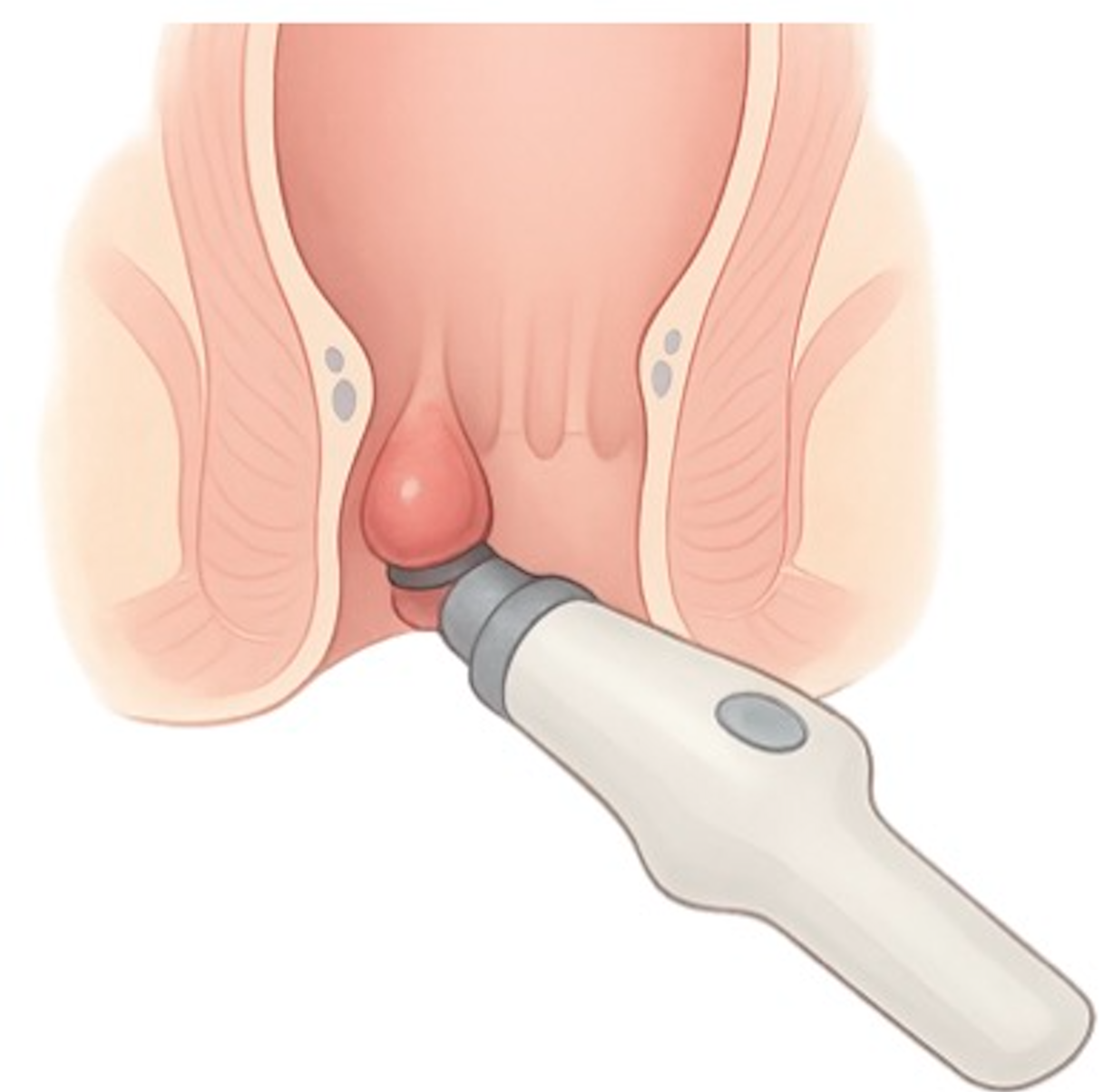
Rubber band ligation — Read more →
A small elastic band is placed at the base of the haemorrhoid, cutting off its blood supply. The treatment of choice for grade I, II and III haemorrhoids. Painless, outpatient and with immediate recovery.
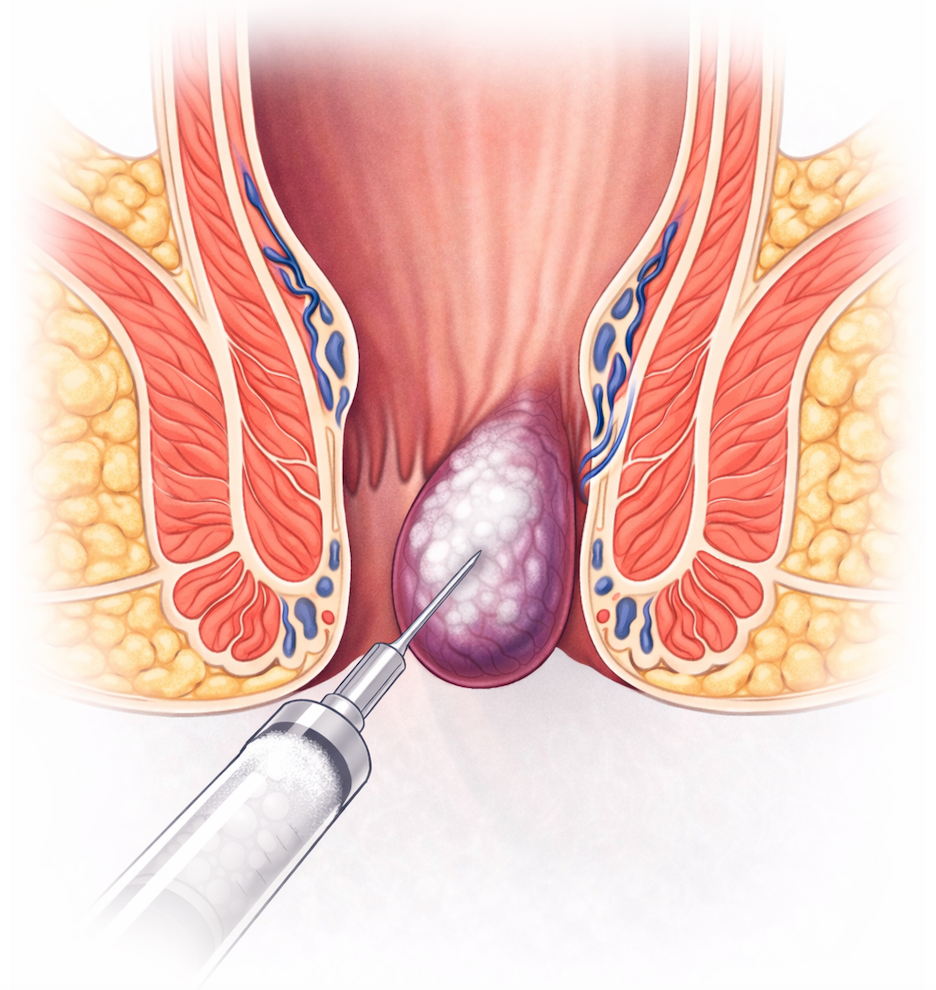
Foam sclerotherapy — Read more →
A sclerosing solution in foam form is injected into the haemorrhoidal vessel, causing it to shrink and obliterate. Particularly effective for grade I and II haemorrhoids where bleeding is the predominant symptom.
ONEstep® Clinic · Clínica de San Pío
Diagnosis and treatment in a single visit
The ONEstep® model means patients do not need to return on a separate date for treatment. In a single visit, the examination, diagnosis and procedure are all carried out. Ideal for expats and tourists visiting the Costa de Almería.
No hospital admission
No general anaesthesia
Immediate recovery
Scientifically proven results
Frequently asked questions about haemorrhoids
Does rubber band ligation hurt?
The procedure is carried out in the anal canal, where there are no pain-sensitive nerve endings. Most patients feel nothing during the ligation. There may be a mild sensation of pressure or fullness during the first 24–48 hours afterwards.
How long does rubber band ligation take to work?
The ligated haemorrhoid loses its blood supply and falls off within 5–10 days. Bleeding usually stops within the first week. Improvement in prolapse may take 2–4 weeks. In some cases a second session is needed.
Can I return to work the same day?
It depends on the procedure. After foam sclerotherapy, recovery is immediate and patients can resume normal activity the same day. After rubber band ligation, most patients return to their usual routine within 24–48 hours. Neither procedure requires hospital admission or general anaesthesia.
Can haemorrhoids come back after treatment?
Non-surgical haemorrhoid procedures have a high success rate after 1 or 2 sessions. The risk of recurrence can be minimised with lifestyle changes: a high-fibre diet, adequate hydration and avoiding constipation. Should they recur, the procedure can be repeated without difficulty.
When is surgery actually necessary for haemorrhoids?
Surgery (haemorrhoidectomy) is indicated for grade IV haemorrhoids with permanent prolapse, when outpatient procedures have failed, or in cases of acute thrombosed haemorrhoids. In general, fewer than 10% of haemorrhoids require surgery.
I am an expat living in Spain — can I be seen in English?
Yes. Dr. Jaime Jorge Cerrudo offers consultations in English and regularly treats expatriates and tourists from across the Costa de Almería. No Spanish is needed and no GP referral is required — you can book directly by phone or WhatsApp.
Experiencing symptoms? Don't put it off
Dr. Jaime Jorge Cerrudo provides diagnosis and treatment in a single appointment at Clínica de San Pío, Almería.
We use essential technical cookies to ensure this website functions correctly. By continuing to browse, you accept their use. See our Cookie Policy and Privacy Policy.