What is haemorrhoid foam sclerotherapy?
Haemorrhoid foam sclerotherapy is an outpatient technique that involves treating internal haemorrhoids through the injection of a sclerosing agent (usually polidocanol) in microfoam form directly into the haemorrhoidal tissue.
The microfoam induces a controlled inflammatory reaction in the wall of the haemorrhoidal vessel, leading to progressive fibrosis and obliteration. The result is less bleeding and a smaller haemorrhoidal volume without the need for surgery.
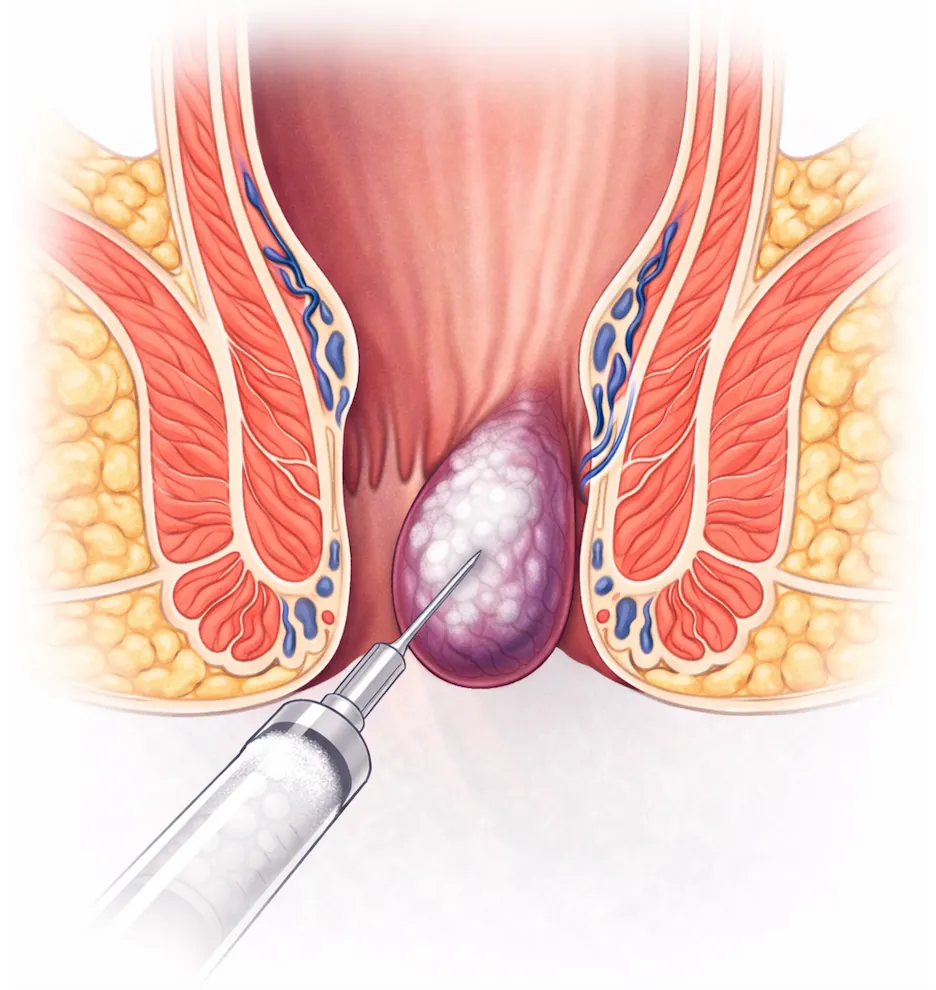
Main advantage: foam sclerotherapy is particularly effective for haemorrhoids grade I and II with bleeding as the predominant symptom. Recovery is immediate — the patient can return to normal activity the same day.
How is the procedure performed?
The procedure is performed at the clinic under topical anaesthesia, with no need for general anaesthesia or hospital admission. The total duration is approximately 10–15 minutes.
Diagnostic anoscopy — direct visualisation of internal haemorrhoids and grading
Preparation of the microfoam — the sclerosing agent is mixed with air to create the microfoam
Submucosal injection — the microfoam is injected at the base of the haemorrhoidal bundle, into the submucosa
Immediate discharge — the patient can go home with no need for admission or recovery period
Indications: who is a candidate?
Foam sclerotherapy is particularly indicated for:
- Internal haemorrhoids grade I — without prolapse, with bleeding as the main symptom
- Internal haemorrhoids grade II — with spontaneously reducible prolapse
- Patients with recurrent haemorrhoidal bleeding without sufficient response to medical treatment
- Patients on anticoagulant or antiplatelet therapy (prior assessment required)
- Patients who wish to avoid surgery or more invasive procedures
Contraindications
- External or acutely thrombosed haemorrhoids
- Grade III or IV haemorrhoids with significant prolapse (rubber band ligation preferred)
- Active perianal infection
- Known allergy to the sclerosing agent
Results and efficacy
Foam sclerotherapy has a high efficacy rate for controlling haemorrhoidal bleeding, especially in grades I and II. Bleeding usually stops or reduces significantly after 1–2 sessions.
In some patients the procedure may need to be repeated. The recurrence rate can be minimised with lifestyle changes: a fibre-rich diet, adequate hydration, and avoiding constipation.
ONEstep® Clinic — Diagnosis and treatment in the same appointment
Dr. Dr. Jaime Jorge Cerrudo realiza la examination, el diagnosis y foam sclerotherapy in the same appointment where possible, with no need de programar una segunda cita.
No general anaesthesia or hospital admission
Immediate recovery
10–15 minute procedure
High success rate for grade I and II
Frequently asked questions
- Davis BR, Lee-Kong SA, Migaly J, Feingold DL, Steele SR. The American Society of Colon and Rectal Surgeons Clinical Practice Guidelines for the Management of Hemorrhoids. Dis Colon Rectum. 2018;61(3):284-292. PubMed
- van Tol RR, Kleijnen J, Watson AJM, et al. European Society of ColoProctology: guideline for haemorrhoidal disease. Colorectal Dis. 2020;22(6):650-662. ESCP
- Gallo G, Martellucci J, Sturiale A, et al. Consensus statement of the Italian Society of Colorectal Surgery (SICCR): management and treatment of hemorrhoidal disease. Tech Coloproctol. 2020;24(2):145-164. PubMed Central