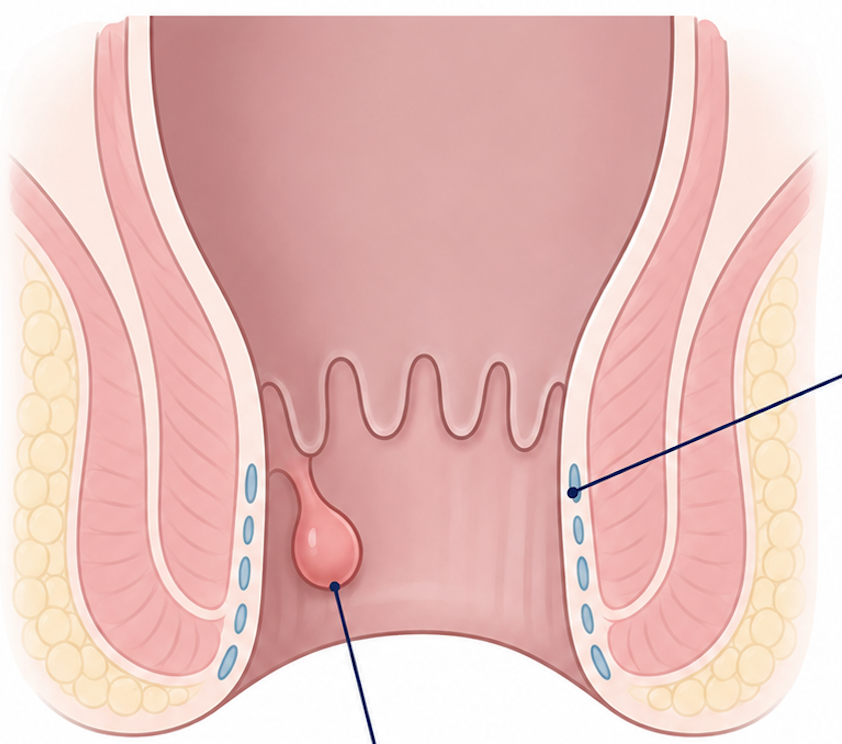
What are anal polyps?
Anal polyps are abnormal growths of tissue arising from the mucous membrane lining the anal canal or lower rectum. The vast majority of anal polyps are benign, but some types have the potential to become malignant over time — which is why removal and histological analysis are always recommended whenever a polyp is found.
They are more common than generally thought, and many patients are unaware they have one until it is detected incidentally during a routine examination. Their size can range from a few millimetres to several centimetres.
Important: the vast majority of polyps are not cancerous, but all polyps should be removed and analysed under the microscope to rule out malignancy with certainty. This is a simple outpatient procedure that takes only a few minutes.
Types of anal polyps
Hyperplastic polyps
The most common type. Virtually no malignant potential. Usually small and discovered incidentally. Removal is recommended for certainty.
Adenomatous polyps
These carry a higher risk of becoming malignant over time. Complete removal and histological study are essential. Regular follow-up is recommended.
Inflammatory polyps
Associated with inflammatory bowel conditions such as Crohn's disease or ulcerative colitis. Management is linked to the underlying disease.
Hamartomatous polyps
Less common. Associated with hereditary syndromes such as Peutz-Jeghers. Specialist evaluation and follow-up are required.
Living on the Costa de Almería? Dr. Jaime Jorge Cerrudo consults in English and sees patients from Roquetas de Mar, Aguadulce, Mojácar, Vera Playa, and across the province. Private appointment available within days — no GP referral required.
Symptoms
Most anal polyps cause no symptoms and are found by chance during an examination. When they do produce symptoms, these may include:
Bright red rectal bleeding
Sensation of a lump in the anal canal
Mucous discharge from the anus
Itching or anal discomfort
Change in bowel habit
Feeling of incomplete evacuation
Key point: rectal bleeding should always be assessed by a specialist. Although it is often caused by benign conditions such as haemorrhoids or polyps, it is important to rule out other causes.
Procedure: how is an anal polyp removed?
Initial assessment
A full clinical history is taken and a proctological examination is performed, including anoscopy if necessary, to visualise the polyp and determine its characteristics.
Local anaesthesia
The area is numbed using a local anaesthetic. Depending on the location and size of the polyp, this may be achieved with an anaesthetic-containing lubricant gel applied directly to the anal canal, avoiding the need for an injection in most cases.
Excision of the polyp
The polyp is removed completely using surgical instruments. The technique varies according to the size and location of the polyp, always aiming for complete excision with a clean margin.
Histological analysis
The excised tissue is sent to the pathology laboratory for microscopic examination. The result confirms the nature of the polyp and guides any further follow-up required.
Same-day discharge
The patient goes home on the same day. Recovery is rapid, and normal daily activities can usually be resumed within a few hours.
Simple procedure, important result
Removing an anal polyp is a quick, straightforward procedure that takes only a few minutes under local anaesthesia. The most important step is the histological analysis, which provides certainty about the nature of the tissue and determines whether any follow-up is needed.
Local anaesthesia — no general anaesthetic
Outpatient procedure at the clinic
Histological analysis of all removed tissue
Same-day discharge and rapid recovery