What is haemorrhoid rubber band ligation?
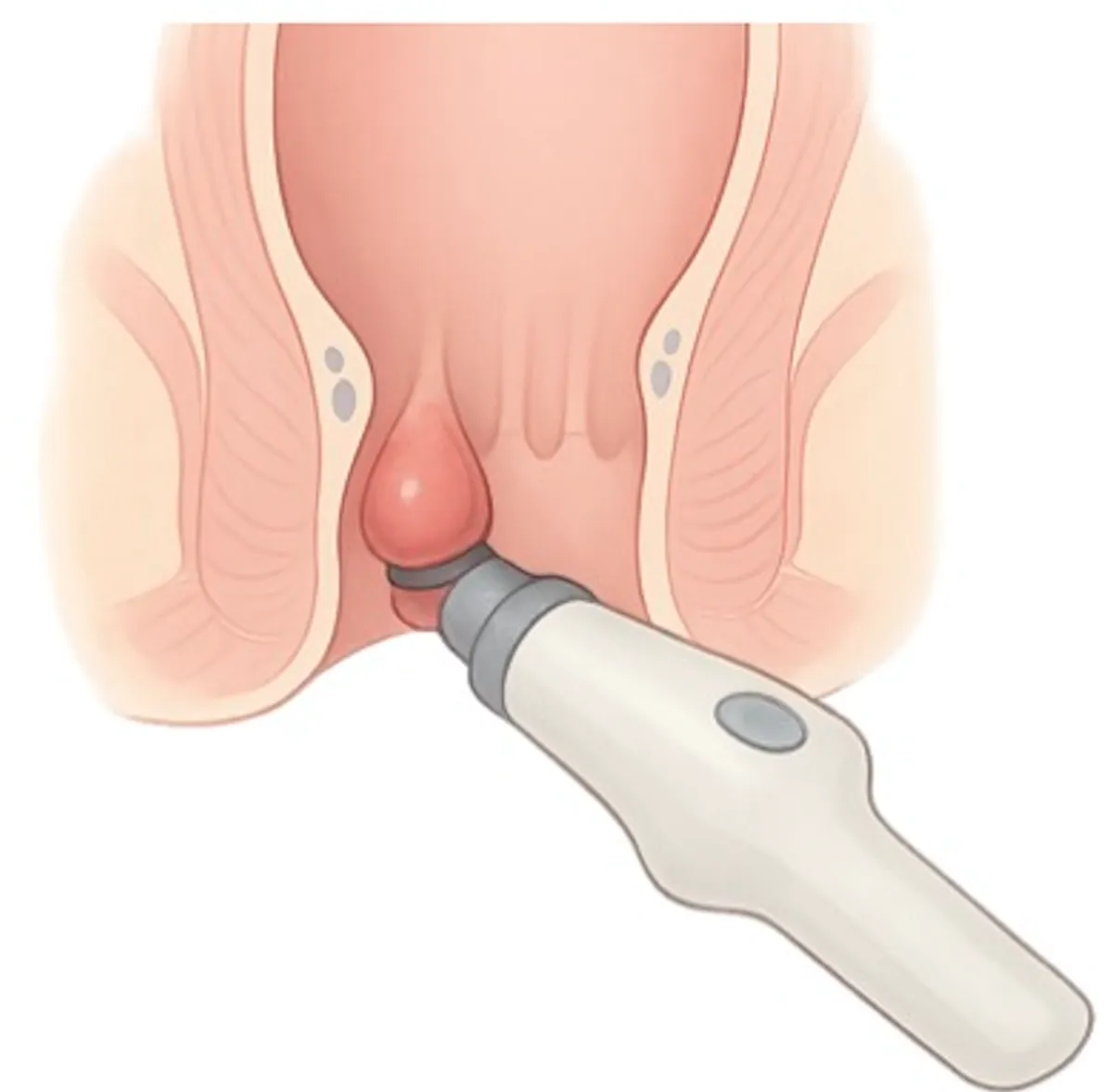
Rubber band ligation is the most widely used non-surgical technique for treating grade I, II and III internal haemorrhoids. A small rubber band is placed at the base of the haemorrhoid, cutting off its blood supply so that it gradually shrinks and falls off naturally.
It is an outpatient procedure, without general anaesthesia, that can be performed at the clinic in a few minutes. The usual recovery is 24–48 hours.
First-line treatment: rubber band ligation is the first-line treatment for grade II and III haemorrhoids with prolapse. Together with foam sclerotherapy, techniques like this allow around 90% of patients to avoid surgery. According to the ASCRS guideline, most grade I and II haemorrhoids, and some grade III, are resolved with these procedures. The 90% figure is an estimate based on our clinical practice.
How is the procedure performed?
The procedure is performed at the clinic, with no need for general anaesthesia or hospital admission. It takes approximately 5–10 minutes.
Diagnostic anoscopy — identification of the haemorrhoidal bundle to be treated and its grade
Insertion of the ligator — the ligation device is introduced through the anoscope
Band placement — the elastic band is placed at the base of the haemorrhoidal bundle, without touching the sensitive skin
Natural shedding — within 5–10 days the haemorrhoid reduces its blood supply and falls away naturally
Indications: who is a candidate?
Rubber band ligation is particularly indicated for:
- Internal haemorrhoids grade I — without prolapse, with persistent bleeding not responding to conservative medical treatment
- Internal haemorrhoids grade II — with spontaneously reducible prolapse
- Internal haemorrhoids grade III — with prolapse requiring manual reduction
- Patients with recurrent symptomatic haemorrhoidal prolapse
- Patients referred for surgery who prefer to exhaust outpatient alternatives first
- Como complementary treatment to sclerotherapy in mixed cases
Contraindications
- External or acutely thrombosed haemorrhoids
- Grade IV haemorrhoids with permanent prolapse (individual assessment required)
- Anticoagulant therapy (prior assessment required)
- Active perianal infection or coexisting anal fistula
Results and efficacy
Rubber band ligation has a high success rate for treating haemorrhoidal prolapse, with significant improvement in most patients after 1–2 sessions. Bleeding usually settles within the first week.
The recurrence rate can be minimised with lifestyle changes: a fibre-rich diet, adequate hydration, and avoiding constipation. En caso de recurrencia, el procedimiento puede repetirse.
ONEstep® Clinic — Diagnosis and treatment in the same appointment
El Dr. Jaime Jorge Cerrudo realiza la examination, el diagnosis y la ligadura en the same appointment where possible, with no need to schedule additional visits.
Sin anestesia general ni ingreso
Recovery within 24–48 hours
5–10 minute procedure
Around 90% avoid surgery
Frequently asked questions
- Davis BR, Lee-Kong SA, Migaly J, Feingold DL, Steele SR. The American Society of Colon and Rectal Surgeons Clinical Practice Guidelines for the Management of Hemorrhoids. Dis Colon Rectum. 2018;61(3):284-292. PubMed
- van Tol RR, Kleijnen J, Watson AJM, et al. European Society of ColoProctology: guideline for haemorrhoidal disease. Colorectal Dis. 2020;22(6):650-662. ESCP
- Gallo G, Martellucci J, Sturiale A, et al. Consensus statement of the Italian Society of Colorectal Surgery (SICCR): management and treatment of hemorrhoidal disease. Tech Coloproctol. 2020;24(2):145-164. PubMed Central