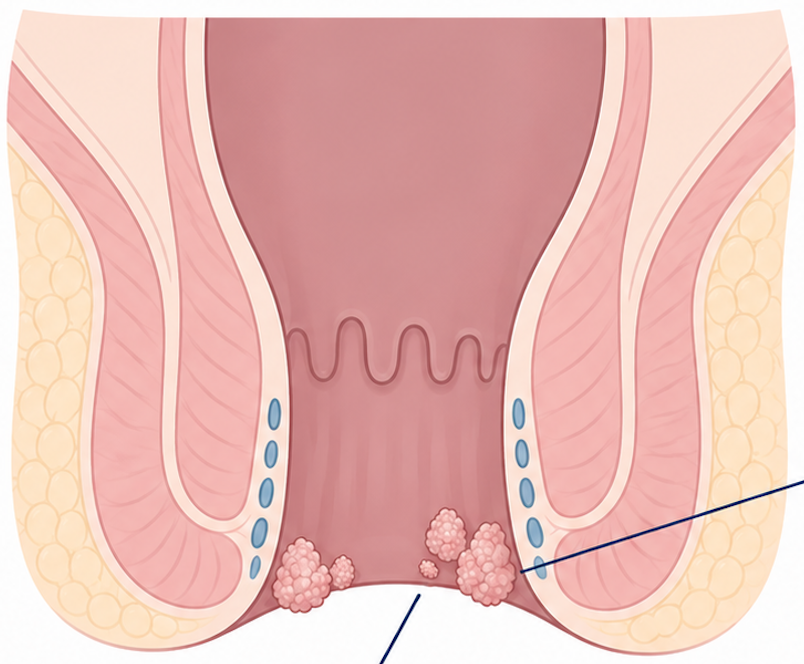
What are anal warts?
Anal warts — also known as condylomata acuminata, HPV anal warts, or anal genital warts — are soft, flesh-coloured or slightly pink growths caused by certain strains of the human papillomavirus (HPV). They can appear individually or in clusters around or inside the anus, ranging from a few millimetres to several centimetres when untreated.
They are transmitted through skin-to-skin sexual contact. Many people who carry HPV have no visible warts and are unaware they are infected, which is why the virus spreads so easily. The warts themselves are benign, but certain HPV strains are associated with a higher risk of anal cancer, making specialist assessment essential.
Important: anal warts do not resolve on their own. Without treatment, they tend to grow in size and number. Early assessment and removal is the most effective approach to controlling the infection and preventing transmission to partners.
Living on the Costa de Almería? Dr. Jaime Jorge Cerrudo consults in English and sees patients from Roquetas de Mar, Aguadulce, Mojácar, Vera Playa, and across the province. Private appointment available within days — no GP referral required.
Symptoms
Many patients have no symptoms at all and discover the warts by chance or during a routine examination. When symptoms are present, they may include:
Visible growths around or inside the anus
Itching or irritation in the perianal area
Sensation of moisture or dampness
Mild bleeding, especially after bowel movements
Discomfort or a feeling of a lump
Mucous discharge
Note: it is not possible to determine the HPV strain or confirm the nature of a growth by visual inspection alone. A specialist assessment is always necessary to establish an accurate diagnosis and rule out other conditions.
Treatment: surgical removal
The most effective treatment for anal warts is surgical removal under local anaesthesia at the clinic. Unlike topical creams — which have high recurrence rates and require weeks of self-application — surgical excision removes the warts completely in a single session, with immediate results.
Specialist assessment
A thorough examination is carried out, including anoscopy when necessary, to map the extent and location of the warts — both external and internal — before planning the procedure.
Local anaesthesia
The area is numbed with a local anaesthetic injection. The procedure is well tolerated and does not require sedation or general anaesthesia.
Surgical excision
The warts are removed completely using surgical instruments. Both external perianal warts and those within the anal canal are addressed in the same session where possible.
Same-day discharge
The patient goes home on the same day. Recovery is straightforward, and most patients return to their normal routine within one to two days.
Follow-up and surveillance
A follow-up appointment is arranged to ensure complete healing and to check for any recurrence. Because HPV persists in the skin even after visible warts are removed, periodic review is recommended.
Why surgical removal?
Topical treatments — such as imiquimod or podophyllin — require weeks of self-application and are generally less effective for large or extensive lesions. Surgical excision under local anaesthesia removes all visible warts in a single session, with immediate results.
Complete removal in a single session
Local anaesthesia — no general anaesthetic
External and internal warts treated together
Same-day discharge and rapid recovery