
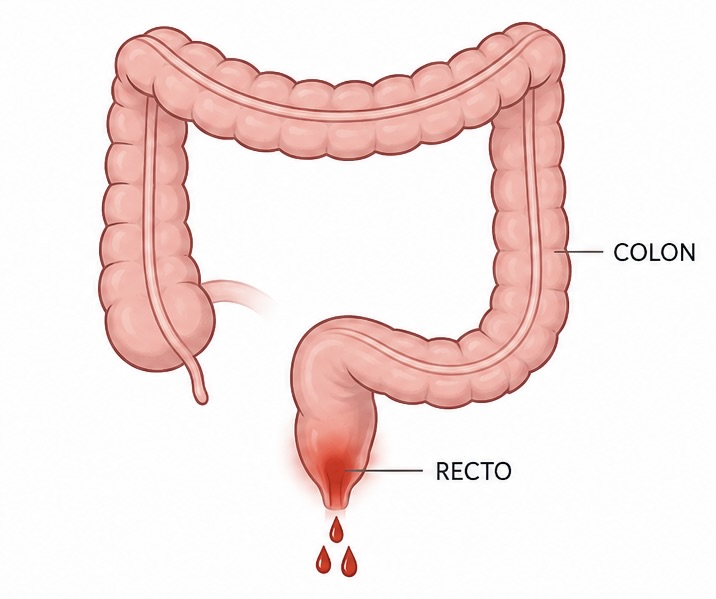
Seeing blood when going to the bathroom is alarming. It is one of the most common reasons patients attend a proctology clinic, and also one that is frequently delayed out of fear of what might be found. This article explains the most common causes of rectal bleeding, how to tell them apart, and when it is important to seek advice without delay.
What is rectal bleeding?
Rectal bleeding refers to blood appearing in the stools, on the toilet paper, or in the toilet bowl after defecation. It may also present as spontaneous bleeding without a bowel movement. The colour and amount vary considerably depending on its origin.
Bright red blood generally indicates a low origin — close to the anus: haemorrhoids, anal fissure, or lesions of the distal rectum. Dark blood or blood mixed with the stools may originate higher up in the digestive tract and requires urgent assessment.
Most common causes
1. Haemorrhoids
The most common cause of rectal bleeding. Inflamed haemorrhoids typically bleed during defecation without associated pain. The blood is bright red, appears on the paper or in the toilet bowl, and does not usually mix with the stools.
2. Anal fissure
An anal fissure is a small tear at the anal margin that bleeds when defecating, usually accompanied by intense pain during and after the bowel movement. In most cases it can be treated without surgery.
3. Anal and rectal polyps
Polyps are benign growths of the mucosa that may bleed intermittently, sometimes without any other symptoms. They should be removed and examined, as some types have malignant potential if left untreated.
4. Anal warts
Anal warts (caused by the human papillomavirus) may bleed due to friction or irritation, often also associated with itching or the sensation of a perianal lump.
5. Proctitis
Inflammation of the rectal mucosa — whether infectious, inflammatory, or due to radiotherapy — can cause bleeding with or without defecation, often accompanied by urgency. It requires specific assessment and investigation.
6. Colorectal cancer
The cause patients most fear, and the one that must never be dismissed without examination. Colorectal cancer may present with blood mixed in the stools, changes in bowel habit, unintentional weight loss, or a feeling of incomplete evacuation. Early detection is essential for prognosis.
How to tell the causes apart
| Characteristic | Likely origin |
|---|---|
| Bright red blood on paper or in bowl, no pain | Internal haemorrhoids |
| Bright red blood with intense pain on defecation | Anal fissure |
| Blood mixed with stools, dark stools | Upper digestive origin — urgent assessment |
| Intermittent bleeding without pain, no bowel changes | Rectal polyp — consider colonoscopy |
| Bleeding with bowel changes or weight loss | Rule out colorectal cancer — urgent |
This table is for guidance only. Only examination by a specialist can establish a definitive diagnosis.
When to seek advice without delay
- Heavy bleeding or bleeding that does not stop.
- Dark blood or blood mixed with the stools.
- Bleeding with persistent changes in bowel habit.
- Unintentional weight loss.
- Bleeding in patients over 50 with no prior diagnosis.
- Family history of colorectal cancer.
- Recurrent bleeding even if small in quantity.
Is there treatment?
It depends on the cause. The two most frequent ones have effective solutions without surgery in most cases:
- Haemorrhoids that bleed are treated by rubber band ligation or foam sclerotherapy, at the clinic, with immediate recovery.
- Anal fissure is treated with botulinum toxin injection, which eliminates the spasm and allows healing without surgery.
- Anal polyps are removed in the clinic itself by electrocoagulation, at the same appointment as the diagnosis.
At the ONEstep® Clinic, diagnosis and treatment are carried out in a single visit, without waiting and without hospital admission.
Do you have rectal bleeding or symptoms that have been going on for some time?
Consult Dr. Jaime Jorge Cerrudo. Diagnosis and treatment in a single appointment at Clínica de San Pío, Almería.
Book appointment — 950 264 245